Thursday, February 25, 2010

Movie making in Gabon

Entering Gabon was easy, it just took some time, as the only official was just about to pick up a letter at the post office.- 26 kilometers away. So, there was a little bit of a delay. However, was not of any importance, as the Gabonese border post was the end of travels by Michels jeep and there was no other transport to continue the journey anyway. With the border official another car arrived and my luck of the day continued.

Rose Canyon, Leconi
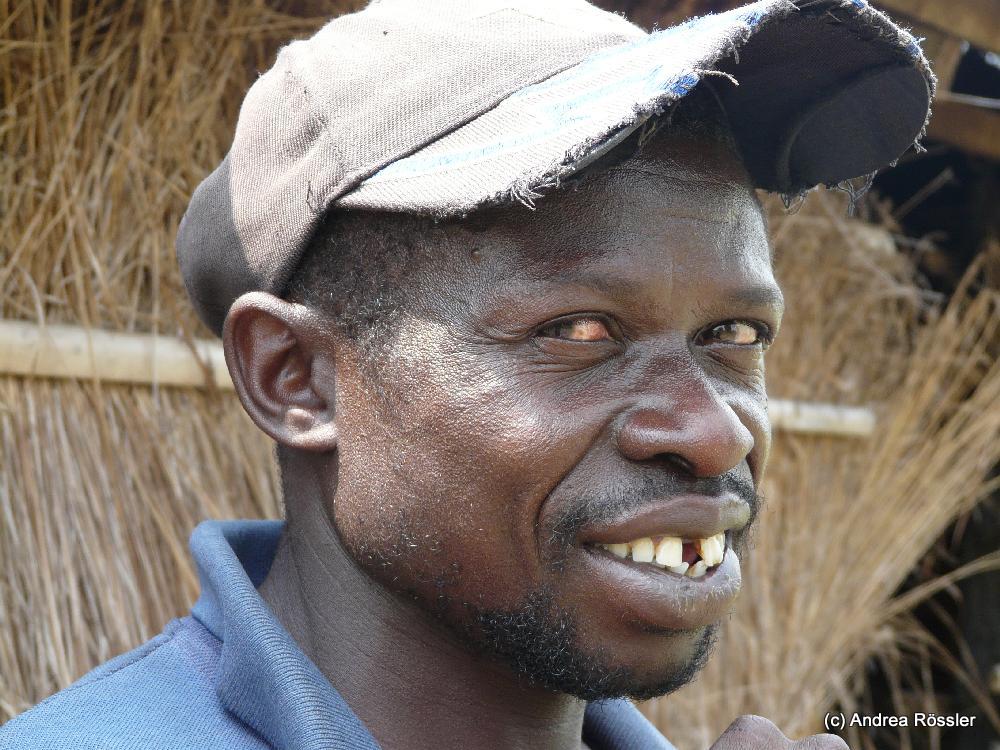
Julian, a friendly man over 60 without a single tooth in his mouth, was pleased to have a tourist in his car and drove me 26 kilometers to the village of Leconi. Here, we completed the entry formalities together. Julian is the boss of a factory for processing of manioc – which is not only used as local food, but also for production of medicine and oil. I never before came across that, so on a trip like this one can really learn a lot! For sure, I was interested to see the factory and the huge manioc plantations. After that, he took me to Hotel Leconi, and as I showed a lot of interest in his work in the factory and as he the boss, he decided on the spot, that I am a VIP guest from Europe, who is paying a visit to the factory, the manioc plantations and village Leconi. So, accommodation and food will be on expenses of the factory…. Wow, that is something unusual! Just imagine a reaction like that in good old Germany!

Rose Canyon, Leconi
At Hotel Leconi, there was also a team accommodated to prepare the setting for the movie "The lion of Poubara". This movie is about lions, which will be freed to live in the jungles of Gabon. Emmanuel, an architect, is working here to construct the huts and villages for the movie. This was very interesting also, as I learned a lot about the former life of people in the villages as well as about the work at a movie setting.
In Leconi itself, there is not so much to do or to see, the treasuries are outside of town. Not far away, but on a dirt road, there is the pink canyon. This canyon shines really super pink, especially in the late afternoon. Unfortunately, the famous infamous porous, very tiny mosquitoes, wake up exactly at the same time. And they can bite really terribly. Later, I also learned, that those bites or stings heal quite badly, above all in this muggy-hot climate with approx. 35 degrees centigrade and a humidity of about 90 percent.

Poubara
Emmanuel
Next day in the afternoon, Emmanuel had to drive to Franceville, so, I got a nice ride in a private car again. In Franceville itself, there is also not so much to see or to do, but the countryside is lovely with a lot of hills and also forests. In parts, Gabon looks like very green hilly parts of Europe, just houses and for sure people look different. Emmanuel was here for work, but as this work was always in the bush, it was for sure interesting for me to come as well! There was also Jean from France, who is in charge for the planning of the setting with the lions, which are to be freed in the forests of Poubara. It was a matter of finding the right place with the right light, the right trees, with possibly many lianas and thick bushes, where it is easy to hide the cage, etc….. Then in the afternoon, Jean left by plane to Libreville and Emmanuel and me went to a small village. Here, the locals had produced huge piles of mats for the movie villages. Now, the mats were counted, loaded in a big truck and transported to Leconi. The negotiations and the counting of the mats lasted much longer than planned. Normally not a big problem, but this time I was a bit pressed in time, as my train to Libreville should go around 7.15 pm… And of course – if you need a local transport to be late, it is certainly on time. Well, to make it short, I missed the train! But for sure, there are more disagreeable places than Franceville to get stuck for 2 days…
Poubara
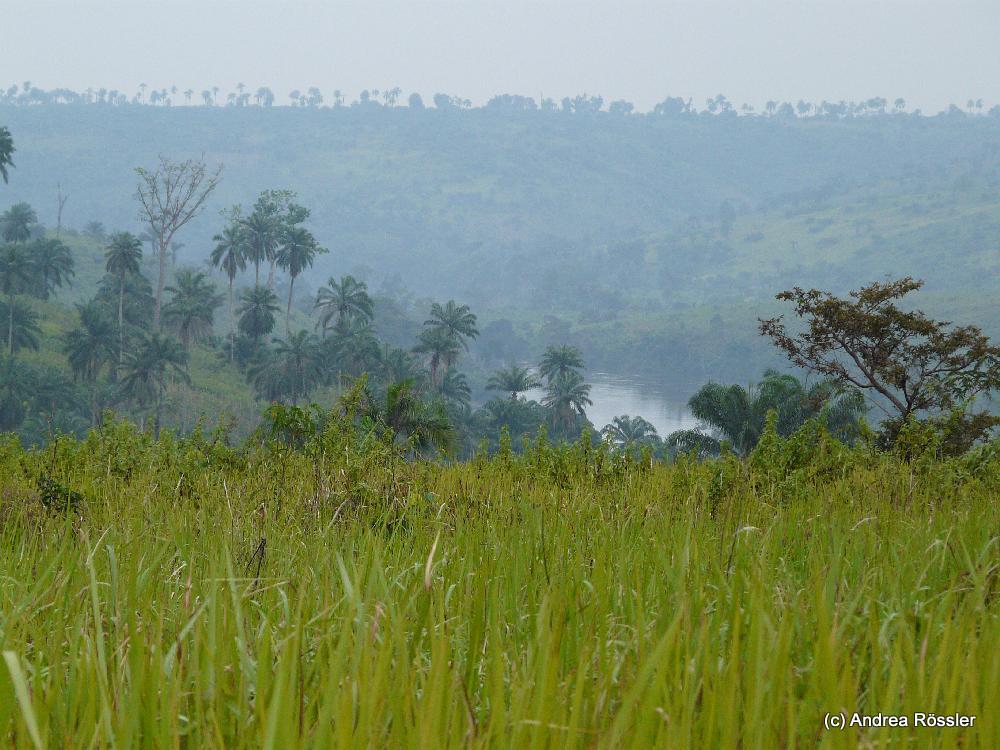
There are quite a few things to see outside Franceville, however, without a car, it is somehow difficult to reach them. About one hour from Franceville and also in Poubara, there is a liana bridge and a big waterfall. As Emmanuel had to go back to Leconi, I took a taxi to go there. Already the journey itself was highly adventurous, since already on the way there a tire burst with a big bang. The bridge was really great. Of course, it was swinging quite a bit, and my guide, an about 12 year-old fellow, had a lot of fun in making it swing even more…. The waterfalls and rapids were impressive, above all the setting in the middle of the rain forest. The way back became even more exciting. Shortly after our departure, the second tire burst. For sure, no one is carrying that many spares. In Gabon as in other african countries, there is of course no phone network in the bush. So, we drove slowly with our broken tire and increasingly more broken growing rim 20 kilometers up to the tarred road. From here we could inform a friend of the taxi driver by phone where we are, so that he can deliver another tire……

Poubara
The same afternoon I found a snake sunbathing just in front of my door… It was not a really big snake, maybe half a meter, but in Africa I do not really trust any of these creatures, especially so close to my room… The waiter, whom I asked for help, had a quick look on the snake, came back with a big piece of wood – this was the end of the snake. Apparently it was a poisonous one, not to die from, but one needs to stay several days in hospital after a bite….

From Franceville it is a long way to the capital of Libreville. Other overlanders told me, that the road to Libreville is in a very poor condition. The train is a lot better option to travel these 820 kilometers. If everything goes well, it takes about 10 hours. However, last week, they had an engine problem and the poor passengers were three full days and nights stuck in the train….. So, I decided, I better stock up on food and drinks before entering that train – one never knows. The train left exactly on time. This allowed me to hope for the rest of the trip. I was travelling first class, as this assured a reserved seat. The first 4 hours I travelled together with a nice Cuban doctor, so we had 6 seats for the two of us. Then 2 more people entered our compartment, which made sleeping less comfortable, but still a lot better than in second class without any possibility to reserve a seat. Strange enough, sometimes, Africans like the cold, the AC in the train was put so cold, that I got up at night to get my sleeping bag out of the backpack. Around 8 pm our train stopped in the middle of nowhere and did not move anymore. There was also no electricity, so it became rather hot within a very short time. Soon, there was the news about a more or less severe engine problem…… Several oil-smeared mechanics came and went, a few uniformed train people came and went without further explanations. We sat like this for 3 hours – then suddenly, the train continued without any further problems to Libreville, where we arrived after 17 hours early in the afternoon.

Saturday, February 20, 2010

Michel - the best host in the world!

Michels house, Okoyo
But it is definitely better and safer to travel a road like this with a local-expert driver in a good jeep than in an old and bad maintained truck. Michel is absolutely an original, indeed, probably a little bit lonely as the only mundele within about 250 square kilometers. Anyway, as my french was already improving and he was speaking slowly and clear, we found a lot to talk and the four-hour journey to Okoyo passed fast. By truck this would have been a trip of half a day – at least!

Michel and the Chinese
Okoyo is a nest with about 3000 habitants, not so long ago without a tarred road, still without electricity or running water. For the road construction workers, housing is a little bit different for sure ­ their houses have air-conditioning and all the other comfort, moreover, there is even satellite internet! Michel occupies some locals as cook, house keepers, etc. When we arrived around midnight, the cook served us a great dinner, which was followed by something I have already dreamed for a long time ­ really good cheese. Well, I am staying with a French man here! In Okoyo, there is not an awful lot to see: there is a small market, one shop, which is better sorted than the others (does not really mean a lot), an elementary school, a hospital (without doctors and without interior arrangement or medicine, because the doctors who have originally worked here, took everything with them to their own private clinics in Brazzaville), there is a police station and various churches – that's it basically.

City center of Okoyo
Not far away, there is a quite big river. On the shores, Chinese workers build two ships at the moment. These ships are supposed to transport goods for the road construction on the river. For sure, as there were so many Chinese people here, local children called me again Chinese…. A lot of my time in Okoyo, I enjoyed staying in the air-conditioned house, it was nice by itself not being on the move at the moment, and I simply took it as a resting place from traveling. I read a lot, watched French TV und spent quite some time at the net, trying to find out about the best way to reach western Africa. All that came with good food, cheese and ham sandwiches, beer, champagne, red whine, pasties, just anything one can imagine. All these things need to be bought in Brazzaville, about 9 hours by jeep. For sure, all these items are imported from Europe, and there is only one shop in Brazza selling all this stuff, probably at whooping prices.
Road to Gabon
As the road here is in a terrible condition, it is used by only few trucks. Which transport goods from Gabon to RC or vice versa. Another possibility are sometimes Chinese trucks which go once a while from Okoyo to Franceville to organize supplies for the road construction. During my four days with Michel, there was only once a truck going to the border with Gabon. And this one we managed to miss. As my visa for RC was only good for 15 days and it was already about to be finished, Michel decided, that he will send me by jeep to the border. One day, one of engineers has to travel all the way to the border anyway to take some photos of the road and the bridges, so why not now.

Road to Gabon
So, I left Okoyo as I came – in a fancy jeep with a driver. However, this part of the road was by far the worst, I travelled on this trip so far….It was 80 kilometers to the border. Astonishing enough, it took us only 4 hours, as the driver was really a good and brave man.The road was really cruel. Here, I also want to say thanks to Michel for his friendship, for organizing everything for me and for being a great host. The border between RC and Gabon are about 20 kilometers from each other, and I was glad that the jeep was allowed to take me all the way to the Gabonese border post, as for sure, in between, there was also no traffic! Crossing of the RC border post was kind of stressful, as the official could not read tourist visas and strictly stated the visa was already expired. It needed some time and argumentation skills to make him allowed me to leave. To be on the safe side, I also just refused to understand the bad word cadeau (present) …. So, after a while he just gave up and let me go.

Thursday, February 11, 2010

Oyo and the stupid thief

Well, I spent more time than expected in Brazzaville, as I was a kind of suspicious of maybe having malaria. So, I wanted to be sure and do a test in a clinic, before heading in the bush. The test was negative, so the following day, I boarded a bus to Oyo.


Oyo
Oyo is the place of the president, here he was born. As a decent president should behave, he looks after his native country and so Oyo has definitely better infrastructure, better streets, schools, administrative buildings and even soon a hospital than other places about the same size (about 10,000 inhabitants). Oyo is also connected by a narrow, but very good tarred road with Brazzaville. Therefore, the coach trip for these 400 kilometers took only 5 hours. In RC, people are very friendly towards strangers, but, nobody thought of me a tourist. Usually, foreigners come here for business.
In East Africa, I was often called mzungu; the equivalent here is mundele (white person). Here, I encountered something a bit bewildering, as lots of children called me Chinoise the french word for Chinese. Well – as in many other african countries, also in RC it is mainly chinese people, who are working in road construction. Local children make quite obviously no difference between foreigners from Asia and Europe, and as I am obviously not black, I must be Chinese. No doubt about this!
In Oyo, I visited the most important things by motorbike: the residence of the president, the huge villas for the big family of the president, the cemetery where the favorite daughter of the president and wife of president Bongo of Gabon is buried, the lodgings for the ministers of the president… Not difficult to find out without even being there, this is the town of the president! And the locals are proud of it.

Oyo
Construction work
Hairdresser, Oyo
In between all these palatial buildings, there is also space for normal citizens. In Oyo, they have a big, well organized market, a harbor for cargo and passenger ships, and a few supermarkets usually run by Lebanese and Mauritanians and all-important: a small chicken barbeque, where half a chicken was sold for only 3 US! Currently, the most important streets around the president palace are a big mess and about to be paved soon, as in mid march, the president will held a big party with many African presidents and all available ministers. Apart from dust and noise due to the road construction, most of the habitants along these roads did not have running water or electricity since weeks, as both was put down because of security reasons. This also affected my hotel, but a bucket shower with water from a nearby river is nothing unusual in Africa, and they also provided candles in the hotel. A problem was the heat at night – 30 degrees centrigrade in the room without a fan is somewhat unpleasantly warm…. Although I am already quite African when it comes to temperatures after more than 8 months traveling here, but, however, 30 degrees is definitely too much. Anything more than 27 degrees for sleeping I still rate as a bit uncomfortable…
Market, Oyo
The original plan was to stay in Oyo only one night, finally, I spent three nights here. The reason was a little bit weird, as I was robbed the first evening – by a young man, which appeared first quite nice and normal. We visited his family and friends, exchanged telephone numbers when we sat together in a small local bar. When I went to the bathroom, I asked him to take care of my backpack. Better not to take a bag in African public toilets… Shortly after he accompanied me back to my hotel, which was very nice as it was already dark, especially; as there was no electricity and the streets were dotted with gigantic holes due to the road construction… The fact, that the camera was missing, I realized only the next morning, when I packed! As I had the telephone number of this guy, I took my miserable french and called. He stated he does have the camera and, moreover, left Oyo this morning for work. I explained in drastic words, that I will finish him in this small village of 10,000 souls, if he does not hand over the camera. First, I went to the police, accompanied by a few hotel employees, some neighbors and other interested people (finally, there is some action in sleepy Oyo), then the military. After that, a lot of people wanted to help and swarmed out in the whole town to tell everyone on the street, whom we search and why… Well, in the early afternoon, the guy got cold feet, and camera was delivered to the hotel by a small boy…

Marietta from Oyo
After that day, I was probably known by at least half of the population of Oyo as the mundele with the camera! In Oyo at least I was not rated any more as Chinese! After all, the delay had many positive sides. First, I got to know Tayssir, a Lebanese and hotel and restaurant owner. As he offered me a special room rate, I moved into is hotel. Moreover, I got to know an absolutely charming local lady, Marietta. We had a lot of fun at the market, went to a tailor, I even tried myself in crushing seeds and palm fruits at her home… I always knew that I am not very good in cooking, but I even failed in crushing seeds into fine powder… Something else happened because of this delay: At Hippocamp Hotel in Brazzaville, there is a book for overlanders, where people can write down their reports about their travels and share their experiences on the way. A lot of people raved about Michel in Okoyo, who happily helps out travellers passing through, even providing them with an AC room in his own house, nice food and all other amenities. He is the big boss for the road construction project between Oyo and the border to Gabon, and for sure, as it was on my way anyway, I wanted to visit this hospitable french guy in Okoyo. It turned out, that Tayssir knows Michel! He gave him a call and so we found out, that the following day, Michel would travel by jeep from Brazzaville via Oyo to Okoyo! I took that as a great sign of destiny and got ready for a lift for the following day! The road to Okoyo is under construction, and therefore still a bad road. This part, I was about to travel by truck.

Saturday, February 6, 2010

Nice and safe in Republic of Congo

Brazzaville
Once you made it into Brazzaville, the place turns out as a very pleasant city. Brazzaville has many restaurants, some hotels, well sorted supermarkets, some internet cafes and lots of taxis. Actually, everything, one needs. There is not so much to see, but this is nothing unusual for African cities. There are a few monuments, a handful of interesting buildings, the city has recovered from the war quite well. First, we paid Ecofac a visit. This is the park management for the Odzala National Park in the north of RC. It was very difficult to find out where the office is, then it was difficult to get info about the park. Supposedly groups go to the park soon, but nobody knows, when. It depends on the number of the participants, how expensive the trip is. So, the question of the group size and of course also of the date is not unimportant. Unfortunately, today, after 5 days in Brazzaville, I do not know more than on the first day. Africa makes me mad sometimes…. But well, on monday I will try again, and if there is no info, I will leave on tuesday towards Gabon.


Taking a bath in river Congo
Shahid is on his way home to the US. We had a great trip through Angola and DRC and have lived our Angola dream. With him it was definitely easier to travel in these both countries and of course also much safer, logically also cheaper, as lots of expenses can be shared. Thanks for the great time, Shahid!
Brazzaville
I will continue by myself now, first within RC to a small place called Oyo, from there a very bad street leads to Franceville in Gabon. This bad road is only travelled by trucks not by public transport. Okay, something new, I did not have trucks on this trip yet!  The next mail will probably come from Gabon, about the continuation of the journey to RC and Gabon. Greetings from Brazzaville. I am always happy about mails.
A few days ago I got the great news that friends of my parents have decided to support Monica and the children in the soupkitchen in Katutura near Windhoek financially. They donate 1000 Euros, so four other children can go to school for a year, including school uniform, books and writing utensils. In the name of Monica and the children many thanks to all who gave some money!!!!!


Tuesday, February 2, 2010

Deported back into DRC!

Kinshasa, DRC
The way back, we took it easy and went by plane. The flight was an air-screw machine with 25 seats and we needed just 75 minutes to reach Kinshasa. We did not plan to spend the night in Kinshasa, but leave after another visit of the arts market immediately by boat to Brazzaville. Well, this was the plan. But things can change very fast, especially in Africa… It took about 2 hours to go through the paper work at the border and till we had the tickets for the boat. So, finally, we crossed the river Congo to Brazzaville. On the other side, a local agent was supposed to help with the paper work there. However, that is, where the problem started. For some reason the immigration officer at the beach in Brazzaville had a problem with our agent, there was a big palaver, shouting and there we already knew, there is something going totally wrong…. The result was immediately delivered: we were escorted by uniformed like dangerous criminals to the boat and were deported to Kinshasa! Just imagine – pushed away by the relatively sure and somehow friendly RC back to DRC. And logically without valid visas for DRC, as they were stamped with the crossing the border of course…. This put the authorities on the other side into big problems, at last they gave to us new visas for only 60. – US per person.


Kinshasa, DRC
Just before it was getting dark, we found ourselves with full luggage on the unsafe streets of Kinshasa. At this time it is anything but easy to find a hotel room. The next day we tried our luck once again. At 7.00 am, we went to the border office at the boat in Kinshasa to meet the chief officer there. He called several times the chief at the other side, until he gave his okay that we could travel. At 10 am, we left again by boat to Brazzaville.. However, this would have been too easy: the officer on the other side again did not want us to enter. Though this time we had pre-booked a hotel in Brazzaville by phone, but the officer did not want to accept that. He wanted to see a reservation on paper. So, we had to call the owner of our hotel to come and fetch us at the beach! We were really happy when he finally arrived. It did not take long and, finally, the paper war was over.

Saturday, January 30, 2010

DRC - Africa extreme...

Kinshasa
Democratic Republic Congo DRC is so gigantic that it is quite difficult to win a more or less
reasonable impression in a few weeks. Many areas are not really good to visit since for many years as there are quite a few civil wars, especially in the eastern areas Ituri and Kivu, which are the formerly tourist areas with all the mountains and the mountain gorillas. So, on my trip I visited only one very small part of DRC, and all that on the western, "safe" side. The capital of Kinshasa is currently a gigantic building site with a lot of dust, too many people, too many cars and smog. Also really hot. Of course also not safe, when it comes to criminal activity, raids and extortion by corrupt officials, policemen and soldiers. It is easy to realize all this as a tourist. Our hotel was in the centre, it was relatively clean and secured by day guards and night watchmen.


King Leopold from Gelgium
There is not so much to see in Kinshasa. We organized our visa for Republic of Congo RC, visited the arts market, where there are great masks and other tourist stuff and were often in Lebanese restaurants. The ethnographic museum with all old masks, music instruments and statues of king Leopold and Stanley is one of the most interesting sights. In Kinshasa, we had to pay attention with taking photos. Though supposedly the old system was abolished that one needs a written confirmation to be allowed to take photos, but not all policeman or soldiers do know about his new policy. In whole DRC there are incredibly lots of uniformed people, who are paid extremely badly and take every chance to improve their low salary by a "donation", a so-called "motivation" or a present called a "cadeau". The first time we encountered this, was right at the border, when the international vaccination pass is controlled – people with the right document give only a small motivation, those with only a written confirmation but not the correct pass give a donation, those without everything pay a lot…. And things like these happened each day.

Bus to Kikwit
After 4 days in Kinshasa we had organized all important things and we were ready for the journey to Kikwit. Quite a few people may ask now: Kikwit – where is that and what is there so important to see that one travels 525 kilometers? According to our guide book Kikwit is only known for a disastrous Ebola outbreak 1995, which caused nearly 200 deaths.The only other thing, the guide book speaks about, are a few waterfalls further away.
Road to Kikwit
Neither Ebola nor the waterfalls were the reason for our trip there, but we had an invitation of Vincent and Celine Uluma to visit them in Kikwit. Vincent has worked one year ago in Guenzburg, the town I grew up, as a doctor. At this time, there were some clinic materials discarded in this hospital – things for OPs, beds, cupboards, medical devices, etc. Will say, a lot of things, they do not have in DRC and were urgently looked for. So, the idea was born to send these things, nevertheless, by ship and truck to Kikwit. The transport costs were paid by Lions Club in Guenzburg. After a long journey, the objects arrived at Kikwit and are used now at several medical centers in the area. When the Lions Club Guenzburg got to know about my trip, the idea arose immediately to get me into contact with Dr. Uluma. However, I had not thought, that he invites us immediately to come to Kikwit and to stay with him and Celine, his belgian wife.
Travelling in DRC
Vincent Uluma
In Kinshasa, we found out, that in the mornings, there are coaches going to Kikwit from a bus stand near the international airport. So, we went there shortly after 7am. There were quite a few busses, all of them for Kikwit. We had more than a closer look on all the vehicles and selected the best looking bus, which already had lots of passengers. We thought, this would be the earliest departure then. It took some time to get started, gigantic loads were delivered and loaded on the roof. This was about 1 pm. Then about 2 pm our backpacks followed on the roof of the bus and shortly after we left. We knew from Vincent and Celine that it would take about 10 or 12 hours to get to Kikwit, which is about 525 kilometers from Kinshasa. So we prepared ourselves on an arrival at night. But once again everything came different than expected. At last we left Kinshasa about 4 pm, after we had spent some time in a garage and in a gas station. More or less 10 kilometers out of town we had a breakdown – a thing of an hour. 5 kilometers later was the next hold, a spare part had to be brought – well, good that we were not jet far from Kinshasa. After the part was delivered and was inserted, we went on in the darkness. There we still thought, okay, for Vincent and Celine it is better if we arrive early in the morning as in the middle of the night….. In the morning around 5am, the bus broke down completely – right in the middle of the worst part of the road. At that time, we did not even cover half of the distance to Kikwit. Most passengers prepared themselves for being stuck for several days in the bush, waiting for another spare part and a mechanic to arrive from Kinshasa or Kikwit. Those with money (not many) looked for some other transport. Therefore, we walked with full luggage to the next village. There was a coach, which was just about finished with its repair. This coach was laying here already for 5 days (not really a proof for a good vehicle), but now it was repaired, and so hopefully in better condition than before and hopefully also better than our first coach. There was also not much choice anyway. We had to pay half a fare per person again and continued our trip.

Landscape around Kikwit
Transport of goods
After other 8-hour journey we arrived in Kikwit after a total of 27 hours. Blond hair is something not seen often in Africa, so the immigration officer in Kikwit found us immediately in the coach and started asking disagreeable questions. Of course, the aim was a gift, a bribe or whatever. But short after our arrival, Celine arrived and got out us there! Mrs. Uluma is already well known in Kikwit, and immediately the haunting was over! We had a great time in Kikwit with Vincent and Celine. We learned a lot about DRC, its history, geography, the people and politics. And of course its great nature, this country is blessed with. When, finally, the country will stop its wars, people could live very well here in the countryside. Of course, the streets need an improvement, also transport. Poverty is big in this country, people are really going hungry to bed here, children are malnutrition and there are many illnesses. There is also a lack of spiritual food, if it is only a cinema. In Kinshasa there is one again, but this might also be only one in the whole country. King is, who has a television, above all at times of the Africa Cup of Nations, when one could really make some money on entrance fees!


Farmer
Lady from a village
We spent 10 days in Kikwit, a town with about 1 million people which seems, however, more like a big village. In the city centre, there are gigantic mountains of mud and sand. With every rain, the mud mountains on the streets grow. The trees, which held on the earth earlier, were cut down and illegal huts were built instead. Since then more and more mud slides in the streets of the town. In Kikwit there is 6 times per week electricity – three times in the mornings for 3 hours, three times in the evening for 3 hours… Richer households and also some of the medical centers (however,
not all) have a generator. Of course, we visited with Vincent many of the medical centers, in which now equipment from Guenzburg is used. Over and over again I also bumped into aluminum boxes of Munk technology in Guenzburg. Everything what was delivered is in use and makes the life of many people here a lot easier! Thanks to those in the clinic and Lions Club Guenzburg, who made this possible. I do not want to know at all, how the situation would be like without all that…. Several times, we went with Vincent in the bush, visited the farm, which is supposed to produce fresh meat for the clinic in the future, we looked after a patient, who lives 120 kilometers away and went to a meeting in the biggest hospital of the area. To see this big hospital with a sister took us 3 hours! One day we could combine the visit of a patient with the visit of the waterfalls of Kakobola. These waterfalls are really gigantic and for sure are rarely visited by tourists.
After 10 days it was difficult to say goodbye to Vincent and Celine. At this point, I would like to thank you so much for your hospitality and patience with our questions. We had a great time in Kikwit and I hope very much that we soon meet again in Europe!

Wednesday, January 20, 2010

Angola - exciting, but very expensive

After Shahid had missed the flight from Johannesburg to Windhoek and had to spend the night in South Africa, finally, he arrived in Namibia 30th of december. After a short walk through central Windhoek and the feeling that the town has clearly changed since his last visit ten years back, we took our bags and went to Katutura, where to bus towards the border with Angola should leave from around 6 pm. It was quite strange to say goodbye to the friends in Windhoek, as I spent 3 weeks there. Monica insisted on taking us to the bus station to make sure that we sit in the right bus! A nice move!
After all, now it started, the adventure Angola. In Chameleon Backpackers I got to know a very nice Angolan family from Luanda. They gave me their telephone number, so if something goes wrong or there is any problem with the extension of my visa, I have friends who can help. The brother of the woman works with the visa authorities in Luanda….. I took this as a good omen! So, on the last days of december Shahid and I left Namibia. The bus was supposed to start around 6pm….. Well, it took some time till the coach was full and so we started at 10pm towards Oshikango. It rained heavily during the journey, we were cramped in the coach and the music they played I would not really call music. But it was a good feeling to be on the road again! Around 8am we reached Oshikango and moved on to the border.
Flag of Angola
Borders in this part of Africa are not as easy to cross as in East Africa or in southern Africa. Crossing the namibian border was no big deal for sure, but to enter Angola was a little bit more of a challenge…. Of course we got a special treatment as we were the only white people queuing up. They picked us out of the normal queue, because our case would be handled by the boss personally. This is rarely good news. In our case it was a delay of about 1.5 hours, as at this early time this gentlemen for sure was not available. When he showed up, he absolutely wanted to see our letters of invitation for Angola. One needs these invitations to get the visa generally. Logically these letters of invitation stay with the embassy, where one applies for the visa. In my case it was even not a letter of invitation of an Angolan person, organization or a hotel, but a letter of recommendation of the German embassy in Windhoek. But the border official did not know this and also did not need to know it. We were asked embarrassingly exactly for our finances, had to prove, that we carry at least in 3000.-US per person and lots of credit cards…. Not that plastic money would be of any help in Angola… Well, finally, after other 30 minutes of questioning we were allowed to enter the country. One of our magic words was presumably the Africa Cup of Nations, the football event which takes place in Angola just a few days later. It is absolutely understandable and very normal, that the both of us specially come from Germany and the States to see football matches in Angola…. Everybody who knows me at least a little bit, knows that my football understanding is still less than rudimentary…. So, this is somewhat a joke, but why not – if this is the reason that we may enter -please, why not!

Lubango
Lubango
After we had changed the US dollar in local Kwanza on the street as there was no bank available, we went to the bus station in Santa Clara, the border town on the Angolan side. The bus was okay, the music definitely better than on the Namibian side, the street in the beginning super nicely tarred and well maintained. However, this changed very fast! Though these were no man-high holes, I had been warned by the few travellers crossing Angola before, this was really a pretty bad roller coaster sand track next to the new to be build road. However, the locals in the bus were all in a good mood.
 This had its reason: a truck before us has lost full whiskey bottles over and over again, which surprisingly enough were not broken. The more whiskey bottles they could pick up on the way, the better the mood became in the bus…. About 8.30 pm and after 9 hours in the coach we finally reached Lubango.
Lubango
At the beginning, our first town in Angola put us on a patience test. It was anything but easy to find a place for the night. All more or less inexpensive hotels (less than 100 US) seemed to be booked up just at the New Year's Eve night. Finally, with the help of several nice local people we found a room for an okay price. Though from the outside the hotel looked quite peculiar, it did not show any name and had no outside door. Oh well, it had a door, indeed, but only the frames, one was able to walk through the frame just like that and there was the reception… But the room was okay and it was possible to lock the door including the frame.
So we tried to solve the next problem: Dinner! In Europe as well as in most other countries of the world it is normally no big deal to organize something to eat on New Years Eve. Not so in Lubango, Angola. Everything was closed, if these are snack bars, cafes, restaurants, supermarkets, markets, there were even no mamas on the street selling food! For not having to go to bed completely hungry, we based ourselves in the piano bar of the Grand Hotel for a drink. Unfortunately, there was also no food there. After we both had slept away New Years Eve, we thought of a nice breakfast the next morning – but also this did not work out, there was nothing to buy, as there was nothing open. So we looked at least for a less expensive room. So, we found pension Jasil. There was no running water and also no private bathroom (what for, if there is no running water anyway). This room was a real bargain for "only" something more than 50.- US. Well, Angola is expensive, and you do not really get a lot for your money…. At least, finally, we got some lunch at the Grand Hotel. As it was buffet style, we could also eat so much that it was enough for the rest of the day. In the afternoon we bumped into Carlos, who has been to London for several months and therefore speaks very well english. Together, we went a little bit outside of Lubango to a church sitting on top of a hill. From there, we had a great view over the town. The next day, things were back to normal again and we found an open restaurant, where we got some breakfast.

Road to Namibe
Nancy, Benguela
Benguela
After changing some more money on the street (On saturdays the banks are also closed of course), we went to the bus station. We were very lucky and got the last seats in the bus to Namibe, a provincial town by the sea. In the bus, there was also Baptista, who had to go professionally to Namibe. He works for an organization, which supports HIV patients. The whole thing is financed by selling of second hand clothes. Baptista is the one, who administers the money and looks after the paperwork. Then he and his partner helped us in the search for an inexpensive lodging in Namibe. From the money we saved in this inexpensive lodging we went to a nice fish restaurant by the sea, and got a very nice plate of seafood with lobster , mussels and scampi! In Namibe, there are nicely restored colonial houses. Even more interesting was a shop selling cornflakes – for the equivalent of 28.- US! The next day we went back to Lubango. This time the sun was shining, so we had a really great view at the hairpin bends and the rock formations on the plateau – really spectacular. The plan was, actually, to continue the same day to Benguela, but there were no busses the same day and even the coach society SGO was booked up for Benguela for the next three days. At least we got tickets for the next day with another company. So, we spent another night at pension Jasil.
Benguela
The journey to Benguela lasted about 6.5 hours and was first going through thick bush, then down the mountains and it became drier and drier. Over and over again we could see stones with red-white marks to warn about mine fields. According to the stones, there are still many areas with land mines lying around. Benguela turned out to be a very pleasant town. There are some really nice old houses from the time of the Portuguese, the town has a lot of places with big shady trees and, besides, the town is by the sea. People are very relaxed and are glad to meet foreigners. The good impression of Benguela is also because of the lodging we found there. We lived in Nancy’s Guesthouse. Nancy is an American lady, who lives since many years in Benguela. She is leading an english school and an attached guesthouse. She has a heart for the few travellers passing through Angola, knows the problems of the expensive lodgings, and she is a mine of information and willing to help with tips and tricks, whether a visa needs to be extended, a lodging in Luanda should be found or an excursion to Lobito be planned. Whatever it is – ask Nancy and your problem is solved. For sure, the hostel is spotlessly clean, there are interesting people as potential teachers living here as well, and there is air-conditioning in each room and a shared bathroom with cold and hot (!) water! An oasis of rest for a traveller! Thanks to Nancy for all her help and the support she gave us!

Benguela
In town, there is a lot to discover, above all interesting things to eat. On our second day Shahid has exaggerated it, however, somewhat – cooked cattle hoofs and afterwards chicken innards…. Well, the very same evening the food poisoning was there, which made him staying in the room and bathroom for the next day. At least he selected the right place for something like that. After one rest day Shahid was fit again and we went to Lobito. Supposedly from there should be every now and then ships going all the way to Luanda. Such a boat we did not find, but Lobito has a good internet cafe, nice restaurants directly by the sea and some colonial houses, so there is enough to keep one occupied for half a day. Thanks to Nancy and the good Paypal we also solved our money problem in getting some more US cash. Nevertheless, Angola is clearly more expensive than expected and this money transaction got us a big relieve.

Road to Huambo
After 4 days in Benguela, we had to leave Nancy and her hospitable place, in which we, nevertheless, spent more time than first planned. The bus to Huambo was going through a wonderful landscape. First, it was very dry, then there were a lot of rocks, finally, scanty green, followed by bushes and trees, many baobabs and finally green fields, the further we drove towards Huambo. In this area, there were less warnings from land mines then next to the Lubango – Benguela road. However, the villages and small towns seemed to be inhabited by only a few people. Lots of the houses seemed to be completely abandoned. The area around Huambo was particularly a battle zone in the last days of the war, I can only suppose that many people have fled at that time and left their houses, which are still empty.
Landscape close to Huambo
Huambo is the second largest town of Angola to Luanda and is at an altitude of about 1500 meters. So, the climate is very pleasant, in the evenings it is even chilly. Huambo was the center of the fights which took place after the armistice of 1988. The war was finished, actually, 4 years before, then in 1992 an election, which was not recognized by UNITA, led to a new conflict. The result was more fighting and the center this time was Huambo. These fights cost the life of several hundred thousand people. The town was nearly completely destroyed, even nowadays there are quite a few houses with shot holes.
Huambo
Huambo was one of the places where we had to look longer for a tolerable place to stay. A Portuguese brought us first to a pension, but the manager wanted to have a funny 80;- US for this room, but this was nothing more than a hole! So we continued to look for something else and found restaurant Gigi. According to our guidebook Gigi is a local restaurant. Basically, we went there to have a drink and to dump our luggage for a while till we found a place for the night. As so often on this trip, things went different. We got to know Raymondo, who is working for radio Huambo. He supplied us with a complete fan equipment for the football matches. While talking to him, we found out, that there are also rooms available at Gigi's restaurant! We immediately went into negotiations and got one of these rooms at an affordable price. At least, we were the first tourists, who stayed in this pension! So, they gave us a special price.

Memorial of the reading soldier, Huambo
Destroyed House from the war, Huambo
Huambo has a little real places of interest, but the locals were especially friendly towards us. There are two big places in town. One has a gigantic monument with a reading soldier. Around this place, there are the most important buildings of town, the governor’s palace, town municipality, post, etc. The other central place is with a lot of green, fountain, a playground and many benches to sit down. In Huambo particularly strikes how young the population is in Angola. We saw hardly people more than 50 years old. Most are more likely clearly under 20! I am not really sure, why it is like this, but there are probably several explanations: The war has certainly cost many adults life’s, whose children now grow up as orphans or half-orphans. Moreover, many people still live in little villages in the countryside, however, the children in bigger towns, the old people remain in the village. Shahid and I were often the Methusalems in the bus or a restaurant in comparison to all others there…
Huambo
In Huambo, we met Edelgard, who works for a German aid company in Huambo. We spent an interesting evening with her and her South African colleague in a restaurant. When we stayed in Huambo, the CAN started, the Africa Cup of Nations, which was held this time in Angola. Of course we sat at Gigi’s restaurant, like the Angolans equipped with Angola flags and Angola caps in front of TV. First, everybody in the restaurant was completely enthusiastic about the game, as Angola was leading 4:0 against Mali. All that went to zero, when the game finally ended with 4:4…. The next day, we had to get up once more early. Early in this case is really early (4.15 am), because our coach to Luanda should already leave at 6.00 am. At this time of the day or more likely night, it is always difficult to find transport to the coach station, but after 30 minutes walking with full luggage we found a shared taxi with a super nice driver who even did not want to accept money of his first tourists! The Angolans were mostly very friendly and curious, when they saw us with the backpacks. Tourists are still a novelty in Angola, even if it is now already 2 years that they issue tourist visas. These tourist visas are still awfully difficult to obtain. So, no wonder, that that many locals have never seen a tourist…. If these people with their big backpacks speak just about 10 words of Portuguese, people become very curious about us…

Luanda
In Luanda we were very lucky to get a room at Cuamm, an Italian NGO working in health in Angola. Lucky, because hotels in Luanda are really expensive and in the lower price range also not safe at all. We paid 100 US, – for our room without own bathroom, which is a real bargain for Luanda, and it was a very safe place with day guard and night watchman!
Luanda is a gigantic town with a lot of slum-like town quarters which spread out round the town and are called Favelas. The first evening we went to the city center along the promenade by the sea for a restaurant, but there was none. In the city center, there are banks, administrative buildings, etc but no normal restaurant. They are about 1 or 2 kilometers from the city center. Even simple restaurants there charge at least 20 dollars for a meal, which is nothing fancy, just a normal meal…. Well, Luanda is currently the most expensive town of the world!

Luanda
One afternoon, we met Helder. I got to know him and his family at Chameleon Backpackers in Windhoek, where they spent their christmas holidays. Helder was a mine of information about Angola, its history, geography, politics and of course its inhabitants. Thanks a lot to Helder for the patience with all our questions!
Luanda
Favela, Luanda
First, we organized our visas for the Democratic Republic of Congo DRC. Getting this done, took us 2 complete mornings. Luanda does not have a lot to keep tourists busy in terms of sights. Still, we needed quite a few days in Luanda, just because everything takes so long to organize. Especially, when you need to go to another part of the city, this can take forever, because the traffic is simply infernal here! For example our trip to Esquinza: this is a place about 15 Kilometers from our hostel, where the coach sets off in direction for Mbanza Congo. The return trip took us about 4 hours! Going there was easy, as a local took us there in his car, going back by public transport was not so funny anymore. Above all, one of the multiple coaches we took just ended its tour in the middle of a Favela. I felt not really good to walk around in such an area without a local. But also here we were lucky, as a nice collective taxi driver, who even spoke good English, came along and took us out of this area…


Africa Cup of Nations, Luanda
Everybody, who knows me just a little bit, knows that I usually do not care at all about football, but as there was this Africa Cup of Nations in Luanda right at that time we have been in the city, this was like a must to visit! Tickets for the games were supposedly sold at the banks, but we could not find out, which bank, as we were sent from one bank to another. So we decided to try our luck by going to the stadium for the game Mali- Algeria. Reaching the stadium is a story for itself – the stadium is very far outside of town, so private taxis are extremely expensive! As we also failed to find a shared taxi, I asked two men sitting in a car, which was richly decorated with Angolan flags, whether they know, how we can reach the stadium by public transport. At least, I thought that I had asked this, in portuguese language, which I do not speak at all… They waved us into their car and we drove off. At that time, I was still mistaken by the thought that they bring us to the next shared taxi…. After about 20 minutes of driving, we thought all this was rather strange, however, we were at the same time curious about where they would take us. After a total of 50-minute journey, we stopped at a coach of full football fans, the driver of our car put some money for the coach in Shahid's hand, and then they turned around and probably drove back the whole way… Anyhow, I must have seemed very persuasive, completely impecunious and absolutely football-fanatic….

Africa Cup of Nations, Luanda
After reaching the stadium, it took us a while to find out, that the games are sold out. Of course, there was still the black market, where we finally got our tickets! The mood in the stadium was great. The first game Mali- Algeria did not have as many visitors as most people came later to see the Angolan team. The stadium for the second game was really nearly full, which means that almost 60,000 people attended. Lots of them wore the national colors, waved flags, had wigs and costumes… Just great! On top of that – Angola won this game! As we feared a veritable traffic chaos after the game, when all visitors drive home at the same time, we left the stadium before the end of the game. Very fast, we found a minibus leaving towards Luanda. Unfortunately, it turned out, that the driver had to help a friend, who got stuck with his car on the highway near the stadium. The towing lasted forever, so we ended up having exactly the problem which originally wanted to avoid by leaving the stadium earlier. It was absolute chaotic on the streets. At last we walked a good 40 minutes till we reached another road, where we found a nice driver, who took us all the way to favela Sao Paulo. After another long walk we found a collective taxi in the city center, from there only 30 minutes by foot to reach the taxis to the Ilha, 10 minutes later we were back in our hostel – shortly after midnight and completely finished…. But it was a great day!

Africa Cup of Nations, Luanda
After 5 days in Luanda we went by a hellishly uncomfortable coach to Mbanza Congo, which is close to the congolese border. This bus was supposed to start somehow in the morning, actually, around 9am, but everybody was there – up to the driver… He came at 10.30am, and thus we could begin our trip. The journey to Mbanza Congo should last, actually, about 10 hours. There are about 450 kilometers, and the street there is in a very poor condition. Of course, it took us longer, but I did not expect us to arrive at the absurd time at 1.30 am at night… The other people in the bus probably had, as everybody made themselves at home in the parked coach to wait for the next transport to the border or at least for daylight…
Kinshasa, DRC
The plastic seats were already quite uncomfortable before and did not become better during the long trip. Prepared with a sleeping-bag and ear plugs it was a kind of okay. The next morning around 6am a collective taxi took us to the border with the Democratic Republic of Congo DRC in Luvu. The border crossing was very time consuming, finally, after 6 hours all passengers of our minibus were on the other side and we continued our journey towards Kinshasa…. By the way, we were the first tourists who passed this border crossing, the officials on the Angolan side spent quite some time in finding the right book to register us leaving Angola here….. Now we are in Kinshasa. An absolutely chaotic town with few places of interest and little charm, but very lively, very African and above all with a lot of inexpensive restaurants! Our experiences in DRC I will describe in another mail. It is really time to send off this Angola post now!